Lost Luggage Mid-Trip Survival Playbook
Report your bag at the airport within 30 minutes, then track it and save receipts.

Lost luggage mid-trip calls for a sequence. This playbook starts with the first 30 minutes at the airport and follows the bag through tracking, essential purchases, and reimbursement. The central rule is simple. Report the missing bag before leaving the airport, then keep the records that let you pursue both the bag and the money.
Why the first 30 minutes at the carousel determine everything that follows
Most missing bags are delayed. That distinction gives you room to stay calm, but it is not a reason to postpone reporting. Once the carousel stops without your bag, the immediate job is to establish where and when it failed to arrive. Leaving without a report makes that harder.
Some airlines give you very little time to report a missing bag, especially on domestic flights, and that time varies by airline. Do not assume you can sort everything out from the hotel. The airport report is the record the airline needs to track the bag and handle later claims, so it comes before shopping for replacements or changing the afternoon’s plans. First, though, make sure the bag has not simply landed somewhere else in baggage claim.
Confirming the bag is actually missing before going to the desk
Check the assignment board again before saying the bag is missing. The carousel for your flight sometimes changes after landing, and bags from earlier flights may have been pulled aside near the baggage office. Then look in the oversized baggage area. Large bags, unusually shaped items, and anything tagged “heavy” can end up there.
A connection gives you another useful check. Ask an airline agent to scan the bag tag number, because the airline’s system can often show which flight the bag is on and where it is in the network. That is more useful than watching an empty belt. If these checks do not produce your bag, go straight to the baggage desk.
Filing the Property Irregularity Report correctly at the baggage desk
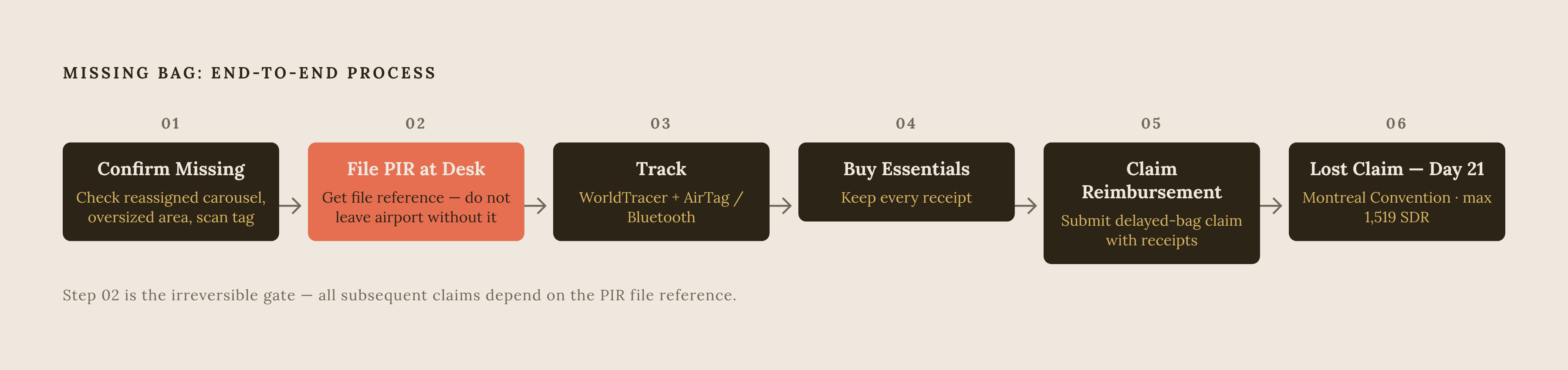
Ask the agent to file a Property Irregularity Report, usually shortened to PIR. This is the central document in the process. Its file reference number connects you to baggage tracking and supports reimbursement and any later formal claim. Get that number before you leave the desk.
Have your baggage claim tag, boarding pass, and ID ready. The claim tag is the sticker stub usually attached to your boarding pass or passport. Describe the bag by brand, color, and size, then add anything that distinguishes it from similar luggage. A colored strap, sticker, or damaged wheel is more useful than “a black suitcase.” Tell the agent what the key things in the bag are too, because those details matter if the airline later declares it lost.
Provide the address where you will be staying over the next several days. Most airlines deliver recovered bags to a hotel or home at no cost, and the agent needs a usable destination. Record the agent’s name and the estimated arrival time you are given. Keep those details with the reference number so that a later escalation starts with a record.
Using trackers and the WorldTracer system to follow the bag in real time
Use the PIR reference number to follow the airline’s tracing process. Most airlines use WorldTracer, which provides updates as a bag is located, rerouted, or dispatched for delivery. The updates are not instant, however. A bag moving between airports may show no change for hours, so checking a couple of times a day is more productive than constant refreshing. Turn on email or SMS notifications where the airline offers them.
A Bluetooth tracker such as an AirTag has its own signal that shows where the bag is. If your bag has one, share its location link with the airline where that option is supported. Many airlines accept these links as supplementary evidence during the search, but support is not universal. Use the tracker to supplement the airline’s tracing system after filing the report.
If the file shows no progress after a couple of days, contact the airline’s baggage department directly with your PIR number ready. Keep a log of each call or message, including the date, agent’s name, and what was said. This gives the next conversation a clear starting point. It also becomes supporting evidence if the case moves from a search to a formal claim.
Buying essentials while the bag is delayed, and keeping the receipts that make reimbursement possible
Ask the baggage desk if it has an amenity kit before buying toiletries, because some airlines offer them. For purchases beyond that, find out what the carrier’s policy treats as reasonable. There is no law that sets a daily shopping allowance for all airlines.
Under the rules that apply, the Department of Transportation requires airlines to pay passengers for lost, delayed, or damaged baggage. Basic toiletries, a change of clothes, a phone charger, and replacement medication are the kinds of necessary purchases that qualify as reasonable. A designer wardrobe or luxury replacements will almost certainly be disputed or rejected.
Keep every receipt for the essentials you buy. Receipts support the reimbursement request for those purchases, while carry-on preparation can reduce what you need to buy immediately. If your carry-on already holds a change of clothes, medication, and a charger, you have fewer things to buy right away. If it does not, focus on what gets you through the delay rather than replacing the entire suitcase before its status is clear.
How AI trip planners can re-sequence a disrupted day while the bag situation resolves
Hours spent at the baggage desk and shopping for essentials come out of the day you had planned, while a delivery may add another constraint. An AI trip planner that can change an itinerary in real time can help you move the remaining activities around to fit. The day’s plan and the time lost give it the information to revise the original order.
If the delay pushes into the next day, a planner with this capability can handle changes to hotel plans or activity timing in the same conversation that built the trip. That keeps the changed plan in one place while you deal with the baggage case on its own. It does not locate the suitcase or replace the airline’s claim process.
For families traveling during school breaks or around pre-booked experiences, an unplanned half-day can be especially costly. They may have little room to make the trip longer or change the time of something already booked. The aim is to preserve the useful part of the day while the search continues.
Filing the formal delayed-baggage claim and understanding the Montreal Convention deadline
The airport report and the reimbursement claim are different documents. A PIR records what went wrong with the baggage, but you almost always need to file a separate claim to get back what you spent. Use the receipts collected during the delay to document what you spent, and follow the airline’s process for submitting them.
For international flights, the Montreal Convention sets the formal claim deadlines. Check the applicable delay deadline and submit the written claim within it. If the bag comes back damaged, check that deadline separately, because the damage window is significantly shorter. The reporting window at the airport and the deadline for a formal claim are not interchangeable.
Under the Convention, an airline’s liability on international flights has a maximum of 1,519 Special Drawing Rights, or SDR, for each passenger. You still have to prove what you lost, and claims for belongings use their depreciated value, which is less than the price of buying them new today. A three-year-old jacket will not be valued as a new one simply because a new one is what you would now have to buy.
US domestic flights follow separate Department of Transportation rules, with airlines publishing their policies within those limits. Check the carrier’s website for the figures and requirements that apply to your flight. Send in a claim with proof on time, even if you have already filed the airport report.
When the bag is officially declared lost and how to pursue the full claim
Airlines use different thresholds for declaring baggage lost, but 21 days is the commonly cited point for international flights under the Montreal Convention when travelers and airlines proceed on the assumption that it will not be recovered. Most airlines declare bags on domestic flights lost sooner than that. Check the carrier’s threshold rather than assuming every flight follows the international timeline.
For the full claim, prepare an itemized contents list with approximate values. Include receipts or proof of purchase for things worth more, and use photos and bank statements to back up the claim if you no longer have the original receipts. Keep the original PIR, bag tag, and boarding pass with the claim. The inventory you gave at the desk now has a concrete role in documenting what was missing.
The Department of Transportation also requires a refund of any checked baggage fee paid for a bag lost in US travel. Pursue that refund as part of resolving the loss. For future trips involving belongings worth more than the international liability limit, airline “excess valuation” coverage may be available at check-in. Before paying for it, check if homeowner’s or travel insurance already covers those things. For the current loss, existing coverage is the next place to look if the airline settlement leaves a gap.
Credit cards and travel insurance as the backstop layer when airline compensation falls short
Start with the guide to benefits for the card used to book the flight. It may include delayed- or lost-baggage benefits that can start on their own without waiting for the airline claim, sometimes sooner. Notification deadlines differ by card, so do not wait for the airline’s final answer before checking them. Missing that deadline can void coverage regardless of what happens to the airline claim.
Travel insurance may provide secondary coverage after the airline settles, while homeowner’s or renter’s insurance can be a less obvious backstop for high-value items. Policies differ in what they cover and when benefits begin. For future trips, read those terms before departure so that you know which protection is available. For this claim, check each type of coverage that applies, even after the airline pays, since you may be able to recover what it left unpaid.
Packing habits that reduce how much a delayed bag disrupts the trip
The best preparation keeps the things you cannot do without out of checked luggage. Pre-load your carry-on with one versatile outfit, all medication, electronics, chargers, and a small toiletries kit. Keep irreplaceable documents and anything that cannot readily be replaced or reimbursed there too, including a wedding outfit. This separates immediate needs from the fate of the checked bag.
Put a Bluetooth tracker in every bag to provide a location signal that can supplement WorldTracer and help the airline’s search. Photograph the exterior and contents before check-in. The outside photo helps the airline recognize the bag, while the photos of what is inside back up your inventory if the bag is declared lost.
Keep a small printed or offline digital record of confirmation numbers and hotel addresses, adding the PIR number if you have to file one. Choose a form that remains usable when the phone dies or the network is unavailable. A tracking tool is less useful when the details needed to use it are out of reach. For a family on a fixed itinerary, these preparations protect more than belongings. They make it easier to preserve the afternoon’s plans after a disrupted morning.