Essay Mid-Trip Rerouting
Train Strike Contingency Plans in Europe
European rail disruption now requires backup plans for entire journeys, not just substitute buses.
European train strike contingency plans in 2026 need to do more than name a backup bus. They need to protect the whole trip when a train, station or connection fails. These plans require a clear sequence of actions: monitoring early, establishing what the operator owes, choosing a route-specific alternative and leaving enough room in the itinerary to use it.
Why 2026 is different: the shift from isolated strike days to permanent rail uncertainty across Europe
Labor action, infrastructure works and sabotage across Italy, France, Germany, Belgium and the UK have made disruption a baseline planning condition in 2026. Different kinds of disruption demand different responses, sometimes on the same journey. Travelers can plan around a fixed strike date, but a closure with no end date leaves them unsure when they can travel.
Italy’s April 2026 national 24-hour strikes affected high-speed, regional and commuter services. By contrast, French rail union Sud-Rail’s summer “rolling notice” allowed localized walkouts without the standard weeks of warning, undermining operators’ ability to arrange volunteer coverage. Disruption also crosses borders, as Belgium’s March 8–11 rail strike and March 12 nationwide strike showed across northwest Europe. That creates two traps, namely the cascade that breaks later connections and the intermediate-stop trap in which a train runs but skips the station where a passenger expects to board.
The current disruption map: what is actually suspended, rerouted, or at risk by country right now
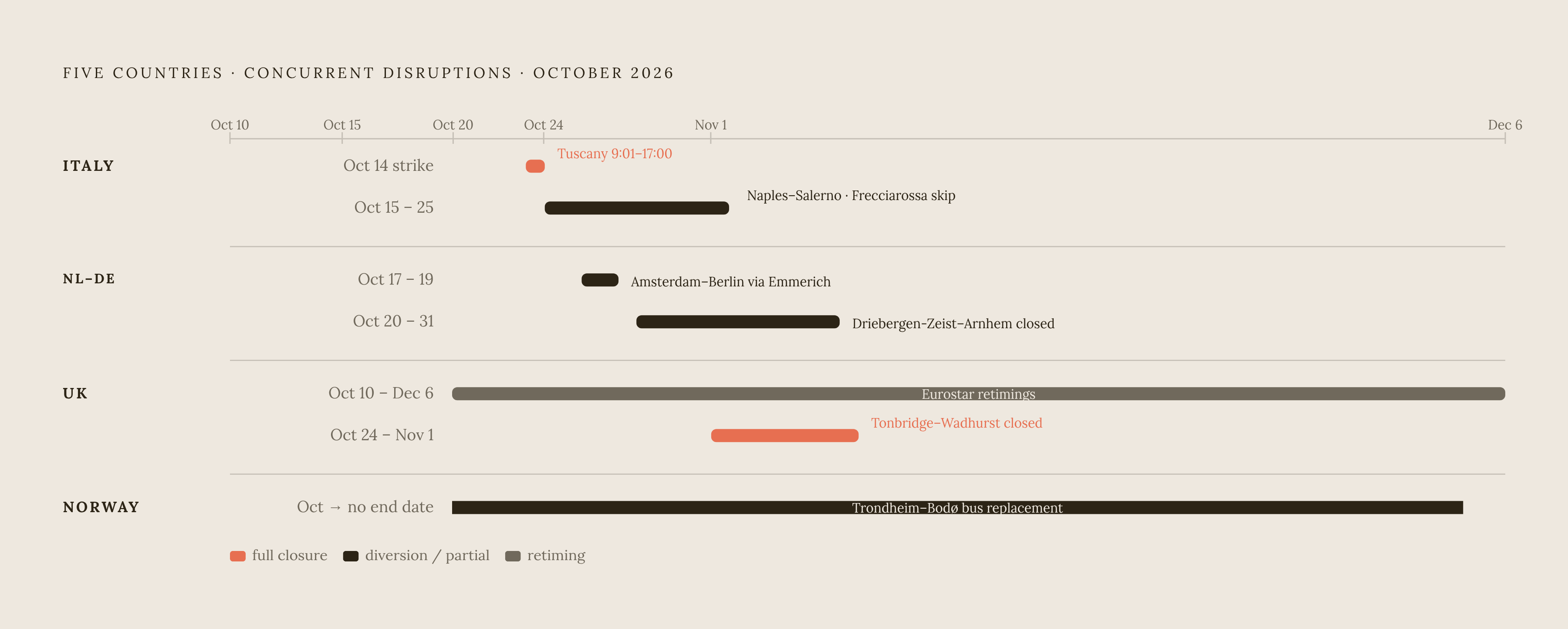
The October 2026 picture requires checking dates and individual services. In Italy, traffic on the Naples–Salerno line via Cava is suspended between Nocera Inferiore and Salerno after a landslide. Rail Europe’s bulletin board has no confirmed end date and lists restrictions on regional services, along with cancellations and delays. The strike by Tuscany FS Group staff on October 14, 2026, runs from 9:01 a.m. to 5:00 p.m. and may affect regional trains in nearby regions too. A separate regional general strike that day may affect services at Florence station, including help for passengers and how staff manage customers.
The CSLE and FI-SI national strike on October 2, 2026, from 11:00 a.m. to 2:00 p.m. brought disruption risk in Lombardy. On Rome–Naples via Cassino, Frecciarossa 9304 skips Cassino and Frosinone on October 15–18 and 23–25, while Frecciarossa 9539 skips them on October 18 and 20–25. Intercity services also change while the disruption lasts, from October 15–25. Rome regional services have cancellations with replacement transport on October 16–18, while Rosignano–Vada has regional timetable changes on October 17–18 and 24–25.
Between the Netherlands and Germany, Hengelo–Salzbergen RB61 has replacement buses and partial cancellations on October 16–25. Amsterdam–Hannover–Berlin services divert via Emmerich on October 17–19, omitting Hilversum, Amersfoort, Apeldoorn, Deventer and Hengelo. Driebergen-Zeist–Arnhem / Wolfheze has phased closures and replacement shuttles on October 20–31, with Arnhem Centraal bus departure points potentially changing. Germany’s Oberhausen–Düsseldorf RE3 has partial cancellations and alternative routing on October 9–30. Earlier, the Netherlands strike on September 8–10, 2026, disrupted Eurostar connections between Belgium, France, the UK and the Netherlands.
For London passengers, Eurostar lists retimings on October 12–16, 2026, within a broader cancellation and retiming period from October 10–December 6. Specific Saturday cancellations fall on October 10–24, November 28 and December 5. Scotland’s Fife Network has phased closures and diversions on October 10–27. National Rail states that Tonbridge–Wadhurst closes completely for engineering work from October 24–November 1, 2026, with replacement buses. In Belgium, Brussels Airport–Zaventem station remains open during October 3–18 works, but some trains skip it or run on changed routes and times.
Pass holders also face disruptions beyond these corridors. Interrail’s disruptions page lists Norway’s Trondheim–Bodø line as fully replaced by buses after a landslide near Levanger, with the end date unknown. Northern Sweden’s direct Stockholm–Narvik night train was suspended from April 13 until at least mid-August 2026, so passengers had to change in Boden during that time, though this does not confirm that the suspension lasts into October. In Serbia, Novi Sad main station is closed, with trains stopping at Petrovaradin and free buses to the city centre. Across this map, an operational line does not prove that a particular stop is served, so match the exact train number to the operator’s notice.
Where and how to monitor disruptions before they become emergencies
Interrail’s travel disruptions page is a practical starting point for multi-country pass travelers because it gathers national carrier disruption pages. Some are available only in the country’s native language, making a translation plugin useful. Rail Europe’s bulletin board carries notices for Eurostar, Trenitalia, Italo and SNCF, including train numbers, time windows and affected corridors. Bookmark the relevant operators’ own disruption pages for every country on the itinerary rather than relying only on the platform that sold the ticket.
However, published cancellations are not always the earliest signal. With French rolling-notice tactics, union social channels and travel-app alerts are also sources of early warning, while Italy’s national strike calendar is kept up to date and should be checked before booking. AI-assisted monitoring can process strike ballots, maintenance notices and air traffic control slot constraints to flag risk before carriers issue cancellations. Its practical value is the chance to find alternative inventory before demand surges.
Italy’s April 2026 national 24-hour strikes affected high-speed, regional and commuter services.
Passenger rights by country: what operators must provide and how to claim it
When a disruption comes up, check what is owed before paying for another way to get there. EU rail passenger rights apply across Italy, France, Germany, Belgium, the Netherlands and other EU member states. They provide for reimbursement or re-routing to the final destination when a service is cancelled or significantly delayed. Operators must also provide assistance when passengers are stranded, which may include hotel accommodation for an overnight delay. The practical questions are whether the operator will reroute the journey, what assistance applies and how to request it.
Tickets are generally valid for diverted services, and passengers should not face an extra charge when the diversion requires a more expensive class or another operator. Package travel has a different point of responsibility, because EU Package Travel rules place the obligation to find alternatives or issue refunds on the package organizer. In Italy, guaranteed service windows also mean that some trains may still run on strike days. The October 2, 2026, notice exempted trains scheduled to depart by 10:00 a.m. and reach their final destination by 11:00 a.m. Check each strike’s notice rather than carrying that window over to another date.
For Eurostar, match the ticket to the published train number and time rather than assuming a running route means an unchanged booking. Replacement transport can also mean a different schedule and limited luggage space. For Delay Repay and other compensation claims, record the delay, retain tickets and boarding evidence, and file promptly through the operator’s official channel. Journey-tracking tools can alert passengers when compensation thresholds are met, but the claim still needs the relevant journey details.
Alternative transport options when trains stop: what works, what doesn't, and by which route
A bus is useful only if it serves the broken part of the journey in time. Operator-provided replacements cover routes including Trondheim–Bodø, Driebergen-Zeist–Arnhem, Ravenna–Rimini and Tonbridge–Wadhurst. Their schedules and luggage limits may differ from the trains they replace. At Arnhem Centraal, check digital station displays on arrival because buses may leave from the Sonsbeek side or the main terminal, depending on the route. Reaching the station is not the same as reaching the replacement departure point.
On Amsterdam–Berlin during October 17–19, passengers at Dutch stops that trains skip must make their own way to a hub where trains still run. Options include regional rail to Amsterdam Centraal before the diversion window or a direct coach to a hub station. Independent coaches need separate tickets because rail passes do not cover them, and more people want seats on their fixed schedules around strike times. Book early if that is the chosen fallback. On Ravenna–Rimini, passengers with cruise embarkation windows should build a minimum three-hour transit buffer for replacement-bus travel.
Flights can be viable on longer corridors such as Paris–Rome and London–Berlin when extended rail suspensions narrow the time and cost gap. However, the airport connection must work too. The works at Brussels Airport–Zaventem on October 3–18 show why travelers who switch to a flight still need to check how they will get to and from the airport. Around disrupted hubs such as Arnhem Centraal, budget for ride-share surge pricing. Multimodal apps can quickly suggest a combined bus-plus-ride-share route after a cancellation, helping assemble a usable alternative.
How to build a strike-resilient itinerary from the booking stage
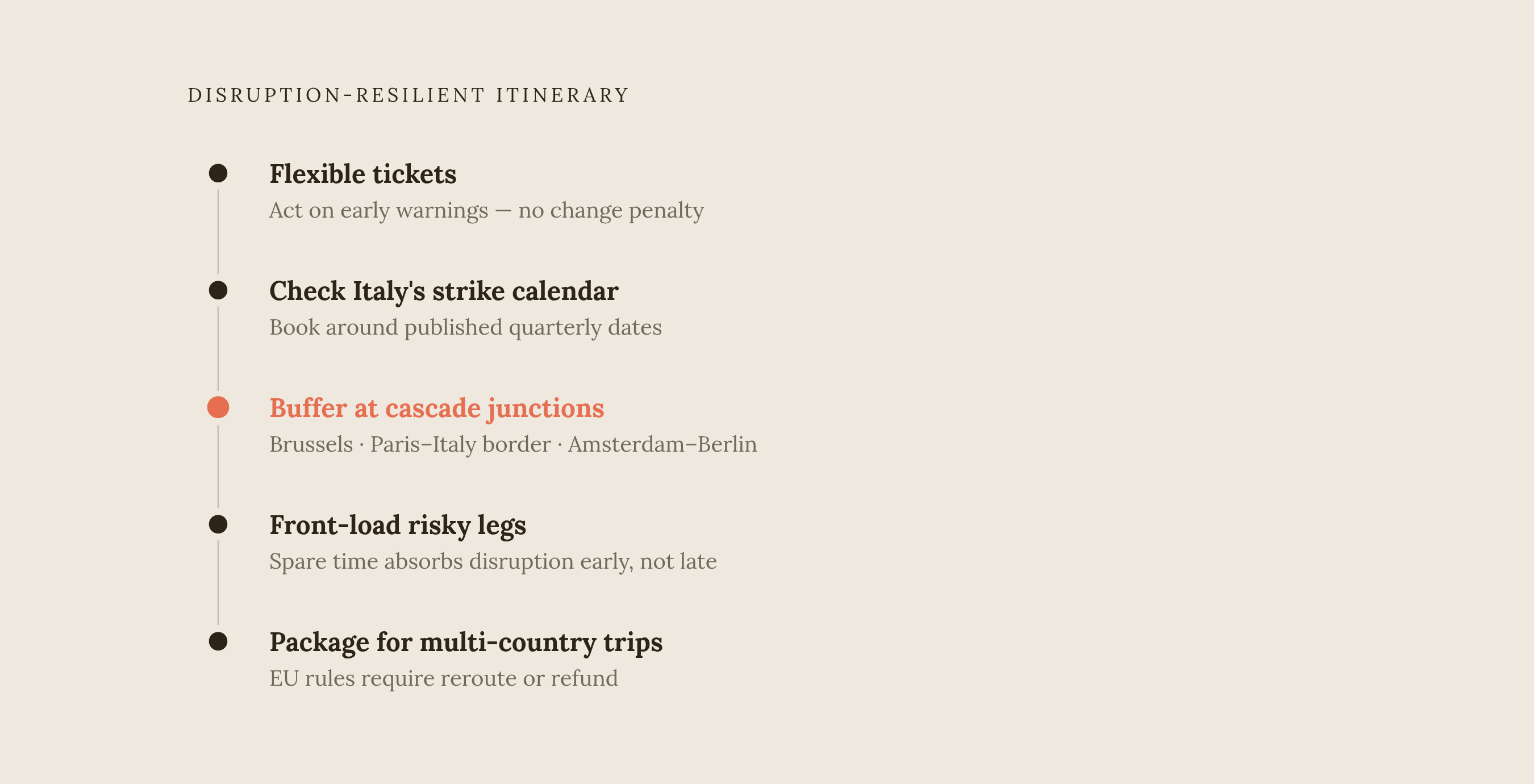
A resilient itinerary limits the damage that any single service failure can cause. Flexible tickets are the foundation because they allow travelers to act on early warnings without heavy change or cancellation penalties. Check Italy’s published quarterly strike calendar before committing to travel dates, then keep watching updates.
Next, put buffer time where disruption can cascade, including Brussels junction, the Paris–Italian border corridor and Amsterdam–Berlin. An extra night near a major hub can protect a trip better than a night at a final destination reached only by regional rail. For trips through more than one country, put the legs most at risk earlier, while there is still spare time, and keep them away from fixed connections home at the end. The aim is not empty time everywhere, but room to recover at the points where it matters.
Booking structure matters as much as the timetable. For a complex trip through more than one country, a package can be worth more in money terms than making each booking alone because the organizer must reroute the trip or give a refund. Planning should also consider preferred pace, tolerance for changes and sensitivity to missed connections from the start. An AI travel assistant can use those questions to show which parts of the trip depend on which transport links before the itinerary is fixed.
How operators and travel agents can turn strike disruptions into a trust-building moment
Waiting for worried guests to write individually leaves uncertainty unanswered and puts bookings at risk. A proactive approach gives affected travelers clear choices before they decide cancellation is the only answer. This approach also takes into account that disruption outside the destination can keep guests from getting there.
The communication sequence has three messages. Well before the strike, tell every affected guest whether the tour is going ahead and offer the choice to keep the booking, reschedule without a fee or take a full refund, asking for replies through one channel. On the morning of the strike, explain what is running, what is not and what guests should do on arrival. A few days after the disruption clears, send the follow-up that operators often skip.
French ATC strikes usually give five to seven days’ notice and German rail actions give about a week on average, but Italian transit unions may give very little notice, so the quarterly calendar helps travelers plan ahead. B2B platforms that bring together live rail inventory from different operators can cut the time agents spend checking services by hand and let them look for replacements before passengers ask. Technology supports the response, but clear options are what make it useful. The strongest contingency plan leaves travelers with somewhere to go and enough notice to get there.