Flight Cancellation Rebooking Options at the Airport
Airline apps and phone lines often rebook faster than gate counters when flights cancel.
This guide to flight cancellation rebooking options at the airport explains what each channel can do and when to use it. Your best chance of getting home sooner comes from checking what the airline has already done, choosing the right channel, and working more than one route to help at once.
Why a cancelled flight at the airport puts passengers at an immediate disadvantage
A bad-weather morning at a major connecting hub can leave thousands of passengers needing new flights at the same moment. The airline may already be rebuilding its schedule, but that does not mean its staff can answer every passenger’s call or question. People spend hours on hold, gate agents face long queues, and open seats go to other passengers while people wait. That leaves a gap between what the airline can process in the background and what a passenger can reach at the counter. Who gets those seats first depends on how fast people act and which channel they try, as well as luck.
What the airline's systems are doing the moment your flight is cancelled
The airline’s recovery work starts before a gate agent reaches your case. Its automated recovery engine picks up the cancellation, finds the bookings it affects, and looks for open seats on flights those passengers can take. That search takes onward connections and passenger profiles into account, so it looks beyond each cancelled flight to the rest of the trip. The system uses fare class, loyalty tier, special-service requests, and connection risk to help decide who gets a seat first. By the time you open the app, it may already have selected a replacement.
Amadeus’s Air Canada case study says Amadeus Passenger Recovery takes minutes to do work that took hours by hand. The case study says the system automates up to 90% of reaccommodation without an agent. For standard single-carrier cases, that can include updating the booking, reissuing the ticket, and checking the passenger in again. Complex ticket reissues and reroutes involving another airline go to a human instead.
The speed of this machinery creates a consent gap. The airline may put you on a later flight before you have decided whether that flight works for you. Check your booking as soon as the cancellation is announced to see whether it has changed. An automatic rebooking is a starting point you can reconsider.
The rebooking channels available at the airport, ranked by speed
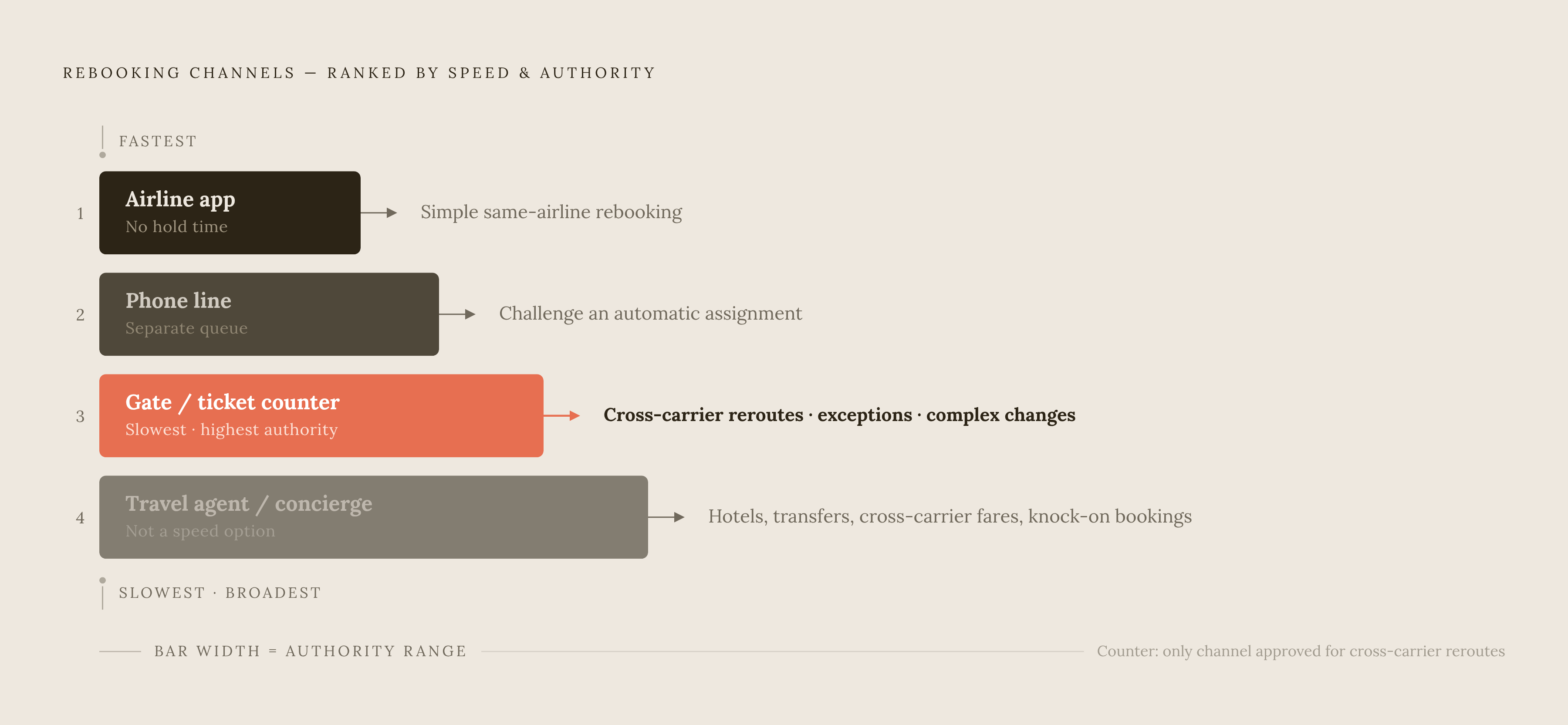
For a simple change, the airline’s own app is usually the fastest starting point. Once a cancellation is confirmed, most airlines show rebooking options in the app from the same seat inventory the gate agent sees. There is no hold time, and you can complete the transaction without waiting for a person. Apps usually show flights on the same airline, so there may still be other routes even if the app shows none that work.
The airline’s phone line is the next route to try while you are still at the airport. It puts you in a separate queue, which may move faster when a local gate area is overwhelmed but the wider contact center is not. If the system has already assigned an unsuitable flight, a phone agent can help challenge that assignment and request another option. A hub-wide disruption can flood the phone lines too, so call early and be prepared to wait. Calling as you walk toward the counter lets you try both at once.
The gate or ticket counter is generally the slowest channel during a mass disruption, but it offers the most flexibility. A human agent can approve exceptions, make complicated ticket changes, and reroute passengers onto another airline. Use the counter when your problem needs authority the app does not have. For a routine rebooking, however, standing in that queue should not stop you from trying the app or phone at the same time.
Travel agent or concierge support is a separate option for passengers who booked through one. It does not fit neatly into a speed ranking because its main advantage is the range of help available. A travel agent can search the same, and sometimes broader, inventory, work on cross-carrier options, apply negotiated fares, and act on your behalf. A well-equipped concierge may also coordinate hotel check-in, airport transfers, and onward connections. That makes this channel especially useful when the cancelled flight has disrupted more than the airline booking.
The practical ranking is therefore conditional. Start with the app for a standard same-airline change, use the phone to reach another queue or challenge an assignment, and rely on the counter when the request needs human approval. Bring in your travel agent when the problem extends across the journey. You do not need to exhaust each route before opening the next one. Whichever channel resolves the booking first makes the others unnecessary.
What you are entitled to ask for, and what the airline controls
Once you reach help, the next issue is what that person or system can offer. Rebooking, refunds, and support during a long wait depend on the circumstances, the airline’s policy, and the rules that apply to the journey. Ask clearly what help you can get under those rules. A request for a different flight is also different from a request for meals or accommodation.
When a cancellation is the airline’s responsibility, rebooking on its next available flight at no charge is standard. That is usually the first solution the automated recovery system proposes. You can accept it, request another flight on the same airline subject to availability, or ask about standby for an earlier departure. United’s standby option illustrates how an earlier possibility can be pursued while a confirmed later seat remains in place. Ask whether you can do that and keep your confirmed booking while on standby.
A flight on a partner or alternative airline is a different request. Cross-carrier rerouting generally needs human approval and will not appear as an automatic option in most recovery systems. The counter is the right place to raise it when the app offers no useful route. Flexibility on the destination, routing, or departure time gives the agent more alternatives to consider. That flexibility broadens the search, but it does not make a particular seat something the airline must provide.
If the cancellation leaves you waiting for a significant period or overnight, ask about meals, hotel accommodation, and ground transport. The airline may have to provide these under its policy, regulation, or both, depending on the trip and what happened. Automated disruption tools can issue vouchers within policy, while exceptions go to a human. Avoid assuming either that all expenses are covered or that a replacement flight is the only help available.
A refund is another option to ask about if the replacement journey no longer works. An airline-initiated cancellation typically gives the passenger a choice of a refund rather than rebooking, subject to the applicable rules. Ask for a clear explanation of the choices, including whether you are being offered a refund, travel credit, or a later flight. Those outcomes are not interchangeable. Before you agree to a travel credit, check its terms and expiration date.
Where AI rebooking still fails passengers — and what to do when it does
Delta Air Lines’ AI concierge reportedly cancelled an entire round-trip award ticket while assuring a passenger that only one flight had been removed. The request was interpreted as a full cancellation somewhere between the conversation and the reservation system. That example exposes the limit of a reassuring answer on a screen. What the assistant says it changed and what the booking now contains can differ. After an AI-assisted change, check the reservation itself in the airline’s app or website.
The Air Canada tribunal case found that the airline was still responsible for misleading information its chatbot gave customers. That matters because an automated answer does not remove the airline’s responsibility for what its service tells customers. It does not, however, make a chatbot conversation proof that the requested ticket change was completed correctly. At the airport, the immediate task is to establish that the journey you need still exists in the booking.
Complex itineraries deserve human help sooner. Cross-carrier reroutes require approval, while fare rules, change fees, and payment authorization for fare differences add friction that automated systems handle inconsistently. An app built for simple flight changes may struggle with a multi-leg or codeshare journey because of these rules. Go directly to the counter or call your travel agent for those cases. If the system has put you on a flight you do not want, call right away to ask for a change while seats on flights you prefer are still open.
A cancelled departure can affect a hotel booking, a car rental, or a connecting tour. The airline’s own rebooking channel handles the flight portion of the disruption. If you have a travel agent or concierge, bring those knock-on effects into the conversation. Otherwise, you need to deal with the rest of the bookings separately and be clear about what to do first.
A working sequence for the first fifteen minutes after your flight is cancelled
First, open the airline’s app and check the booking before doing anything else. Establish whether the flight has simply been cancelled or whether the system has already assigned a replacement. If the new flight works, confirm it. If it does not, treat the assignment as something to change promptly rather than something to accept because it appeared automatically.
Next, match the problem to the channel. Use the app for a simple rebooking on the same airline, or get in the phone queue as you walk toward the counter. For a cross-carrier reroute or a complex itinerary, go directly to a human agent. If the disruption also affects hotels, transfers, or onward arrangements, contact your travel agent or concierge if you have one.
You can stand in the gate queue while calling the airline and checking the app’s options. Let whichever channel reaches a workable result first handle the change, then end the other attempt. If an earlier flight is available only through standby, ask whether your later confirmed seat can stay in place while you pursue it.
Before the agent answers, settle your first and second preferences. Know the flight you want, the alternative you could accept, and whether a refund would be better if neither works. If the wait is significant, ask explicitly about meals, accommodation, and transport. Clear choices give the conversation a direction. They also help distinguish what is unavailable from what simply has not been requested.
Finally, verify the result before leaving the airport. After any AI-assisted or phone-assisted change, open the booking directly in the airline’s app or website and confirm that every leg is correct. If the outcome is a travel credit, note its expiration date. The process ends when you have verified that the booking matches the plan.